Project context
Air lubrication can reduce hull skin-friction drag by introducing a bubble layer between the wetted surface and surrounding water. The project used physical model tests to determine how controllable design and operating variables affect drag-reduction efficiency, while documenting the measurement limitations of an open-water test environment.Back to Projects
Fluid Mechanics / Experimentation
Air Bubble Drag Reduction
Experimental fluid-mechanics researchExperimental designer and data analyst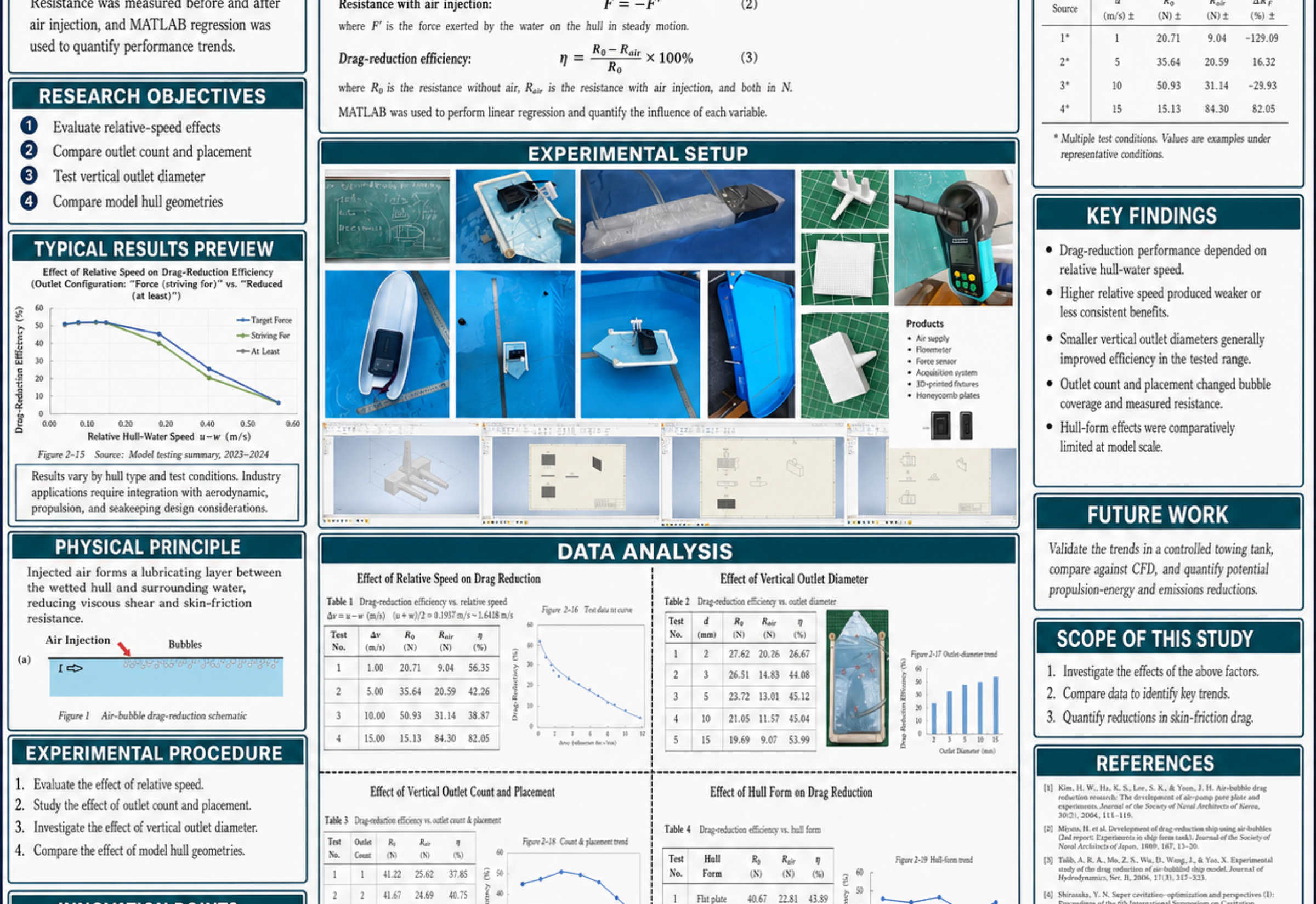
Role overview
Shaofu designed hull models and interchangeable air-outlet fixtures, measured towing resistance before and after air injection, and used MATLAB regression to relate relative hull-water speed to drag-reduction performance.Technical scope
- Defined drag-reduction efficiency as the normalized change between baseline and air-assisted resistance measurements.
- Varied relative hull-water velocity, vertical outlet count and position, outlet diameter, and hull geometry through controlled model-scale comparisons.
- Designed and fabricated hull components and interchangeable air-outlet fixtures for repeatable test configurations.
- Processed force measurements in MATLAB and fitted a regression model to quantify the relationship between relative speed and drag reduction.
- Evaluated uncertainty from wind loading, surface waves, and nonuniform air delivery when interpreting the results.
Outcome
- Observed drag-reduction efficiency increase with relative speed before approaching a stable operating region.
- Found that two centrally located outlets produced the strongest result among the tested placement configurations.
- Observed improved performance from smaller outlet diameters within the evaluated range, while hull-form effects were comparatively limited.
- Established a repeatable test framework for future CFD correlation and higher-fidelity towing experiments.
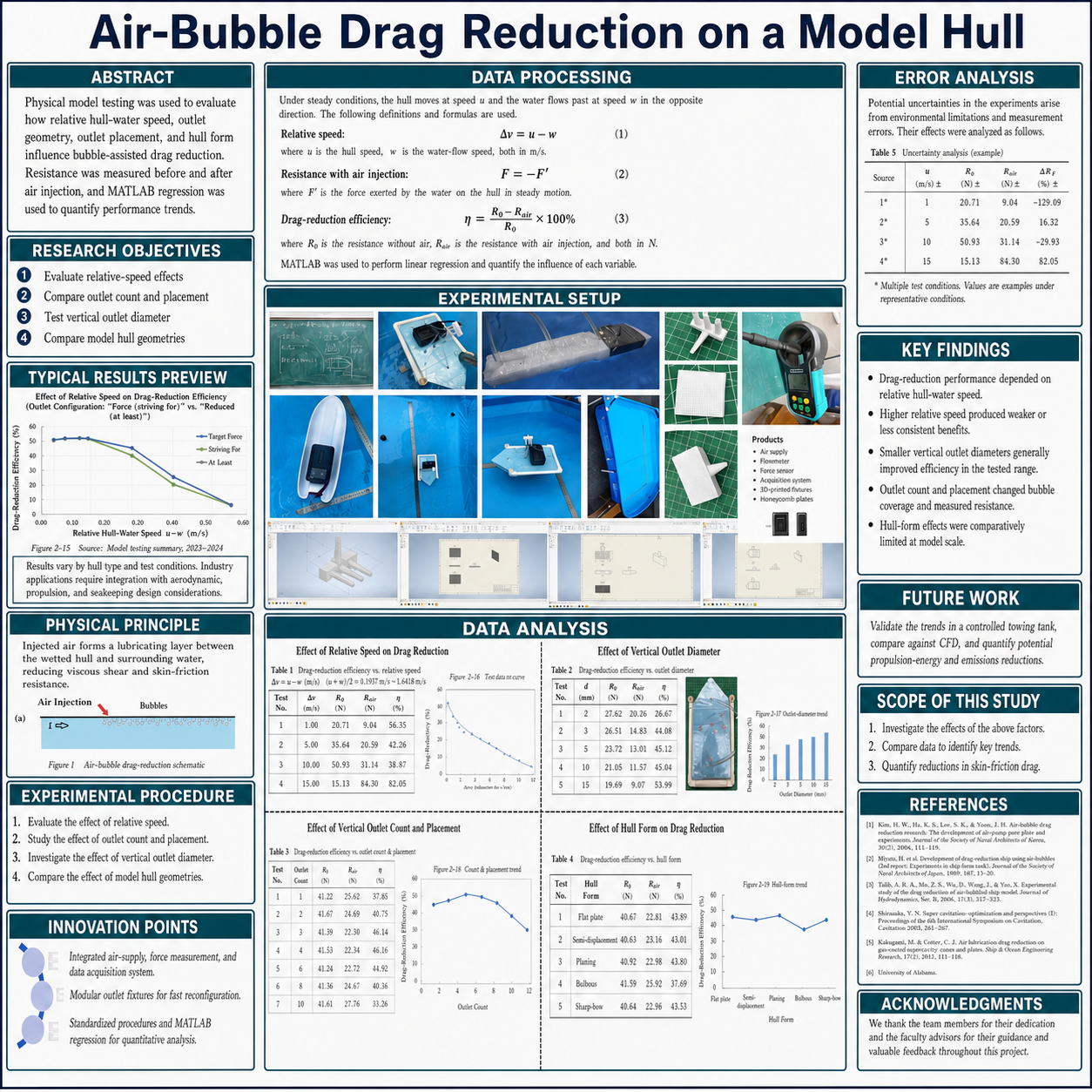
Experimental study
Research poster documenting the physical models, test variables, data reduction, uncertainty analysis, and experimental findings.